New Zealand’s Graduate Work Visa Changes Begin on 16 November 2026
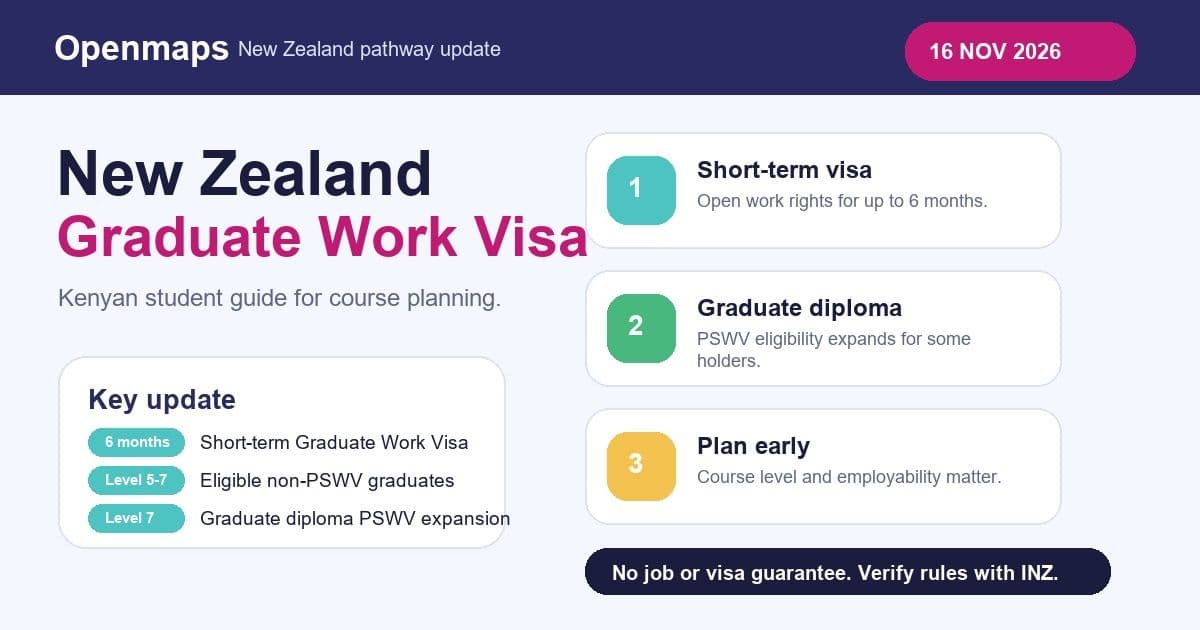
New Zealand is introducing two separate graduate work options from 16 November 2026. The new Short-Term Graduate Work Visa offers up to six months for eligible graduates who do not qualify for a Post-Study Work Visa. A separate change extends Post-Study Work Visa eligibility to certain graduates who complete a Level 7 graduate diploma in New Zealand and also hold a bachelor’s degree.
For Kenyan students comparing courses, the distinction matters. A Level 7 label alone does not tell you which visa a qualification may support. Check the exact award, how long you will study in New Zealand, whether you will use credit transfer and whether you already hold a bachelor’s degree. If you are already studying, check your student visa expiry and any previous graduate work visas as well.
Who May Qualify for the Six-Month Short-Term Graduate Work Visa?
Immigration New Zealand (INZ) says the Short-Term Graduate Work Visa is for eligible graduates who do not qualify for a Post-Study Work Visa. It allows work in New Zealand for up to six months and cannot be extended or granted a second time.
The main checks include:
- Qualification: You must complete an eligible qualification at Level 5, 6 or 7 on the New Zealand Qualifications and Credentials Framework (NZQCF). English-language, foundation and bridging qualifications and micro-credentials are excluded.
- Study in New Zealand: You must complete at least 24 weeks of qualifying full-time study in New Zealand. Do not use the total calendar length on a course brochure as your only check.
- Application timing: You must apply no more than three months after the student visa for the qualification you are relying on ends.
- Available funds: You need evidence that you can access at least NZD 5,000 to support yourself. This is a funds requirement, not the visa fee.
- Visa history: You cannot have previously held a Short-Term Graduate Work Visa or a Post-Study Work Visa.
- Other requirements: Check INZ’s health, character and other criteria, including any additional approval required if your study was supported by a Manaaki New Zealand Scholarship.
INZ counts exam preparation and exams towards the study period. It excludes main holidays, time spent repeating failed papers or units, and study undertaken for a different qualification that was credited towards the award. If your programme included breaks or credit transfer, ask the provider for a breakdown of the study you actually completed.
The three-month application window is not permission to stay or work after your student visa expires. Check your immigration status separately if there is a gap between your visa expiry and your planned application.
What Changes for Level 7 Graduate Diploma Holders?
Under the Post-Study Work Visa extension announced by INZ, an eligible applicant must complete a Level 7 graduate diploma, study it full-time in New Zealand for its entire duration and also hold a bachelor’s degree. The bachelor’s may have been completed in New Zealand or overseas, including in Kenya. Cross-crediting or recognition of prior learning does not qualify under this specific extension.
INZ says the visa can be granted for the time spent studying the graduate diploma in New Zealand, up to one year. That cap does not mean every eligible graduate will receive a full year. Applicants will need evidence of their graduate diploma, a copy of their bachelor’s degree certificate and an official academic transcript.
A graduate diploma is not the same award as a bachelor’s degree. If you do not hold a bachelor’s, you do not meet the bachelor’s requirement for this extension. However, INZ says some graduate diplomas listed in Appendix 13 may still support a Post-Study Work Visa under a separate route with occupation-specific work conditions. Check that option before assuming the six-month visa is your only route.
Check Your Course and Visa Position Step by Step
Step 1: Identify the Exact Qualification
Ask the provider for the full award title, NZQCF level and expected study dates. If your offer includes a pathway, more than one qualification or credit for prior study, ask which award you will actually complete and how much of it you will study full-time in New Zealand.
Step 2: Check the Post-Study Work Visa First
Start with the Post-Study Work Visa criteria for your exact qualification. If you qualify for that visa, the short-term route is not an alternative you can choose instead. If you do not qualify, check whether your completed award and study period meet the short-term rules.
For example, a Kenyan bachelor’s graduate comparing Level 7 graduate diplomas should check whether the offer involves full-duration study in New Zealand without cross-crediting. A student completing a Level 6 qualification should first check whether that award already supports a Post-Study Work Visa, then assess the short-term route if it does not.
Step 3: Check the Effect of Credit Before Accepting It
Credit transfer may lower tuition or shorten your course, but it can also change the study period that counts for immigration purposes. Ask the provider to show the planned study duration with and without credit. Compare each plan against the official criteria before deciding.
The two routes treat credit differently. For the short-term route, earlier study credited from a different qualification does not count towards the 24 weeks. The Level 7 graduate diploma extension requires full-duration study and does not accept cross-crediting or recognition of prior learning.
Step 4: Build a Completion and Application Calendar
Record your last assessment date, expected results date and student visa expiry. Ask your provider when it can issue evidence that you completed the qualification. For the short-term route, INZ lists a qualification certificate, academic transcript or a provider letter confirming completion or eligibility to graduate as evidence options. You do not necessarily have to wait for the graduation ceremony.
If completion evidence is delayed or your visa is close to expiring, check your options promptly. Do not assume that waiting for a result extends your permission to remain in New Zealand.
Step 5: Check Family Arrangements Separately
The Short-Term Graduate Work Visa can allow you to support visitor visa applications for a partner and dependent children. You cannot include them in your own application, and the short-term visa does not make them eligible for a work or student visa based on their relationship to you. Do not assume the family provisions match those of the Post-Study Work Visa.
If your budget depends on a partner working or a child studying, confirm their options before accepting a course or making travel commitments.
A Work Visa Is Not a Job Offer
Work permission gives you time to look for employment. It does not guarantee a job, employer support for another visa or residence. If your intended profession is regulated, check whether you need registration before you can practise.
Build a budget that can cover a period without earnings. Use the provider’s careers support, prepare references and look at roles that match your qualifications. If you later consider another visa, check its requirements separately rather than assuming graduate work permission will lead to it.
Common Mistakes
- Choosing a course based on its NZQCF level without checking the exact qualification.
- Treating the six-month visa and the Post-Study Work Visa as interchangeable.
- Counting holidays or transferred study towards the short-term route’s 24 weeks.
- Assuming a Level 7 graduate diploma alone meets the new extension’s requirements.
- Treating the three-month application window as permission to remain or work.
- Assuming a partner can work based on the short-term visa.
- Choosing a course you would not otherwise pursue because of possible graduate work rights.
Francis Mwaura’s Overview
Two students on courses at the same qualification level can have different options because of credit transfer, an earlier bachelor’s degree or their visa history. Get the provider’s written study plan and compare it with the official rules before you put down a deposit.
For Kenyan families, the course should make sense academically and financially even if finding work takes longer than expected. Build the completion timeline, household budget and career plan around what you can confirm, not the longest visa duration you have seen advertised.
How Openmaps Helps
Openmaps Education Agency helps students compare New Zealand programmes, review qualification and study details, organise admission documents and budget for tuition, living expenses and arrival. The team can help identify questions to confirm with the education provider, Immigration New Zealand or an appropriately authorised adviser.
Education providers and Immigration New Zealand make their own decisions. Openmaps cannot guarantee admission, visa approval, employment or residence.
Frequently Asked Questions
When do the changes begin?
Immigration New Zealand lists 16 November 2026 as the opening date for the short-term visa and the start date for the graduate diploma extension. Check the live INZ guidance before applying.
Does every Level 5–7 qualification qualify for the six-month visa?
No. The qualification must meet the study requirements and exclusions. If it already makes you eligible for a Post-Study Work Visa, you cannot use the short-term option instead.
Can a Kenyan bachelor’s degree count for the graduate diploma extension?
Yes. INZ allows a bachelor’s degree completed overseas. You still need to meet the other conditions and provide the required qualification evidence.
Can I use the graduate diploma extension without a bachelor’s degree?
No. The extension specifically requires a bachelor’s degree. Some listed graduate diplomas may support a separate Post-Study Work Visa route, so check the exact qualification.
Does the NZD 5,000 include the visa application fee?
No. NZD 5,000 is the minimum available support funds specified for the Short-Term Graduate Work Visa. Check the application fee separately.
Can I wait until after graduation to apply?
Do not use the ceremony date as your deadline. Check when you can get accepted evidence of completion and when the relevant student visa ends.
Can my partner work on the basis of my Short-Term Graduate Work Visa?
No. The short-term visa can allow you to support a visitor visa application, but it does not give your partner eligibility for a work visa based on your relationship.
Does a graduate work visa lead automatically to residence?
No. Employment, employer-supported visas and residence are separate matters with their own requirements.
Author Box
Written by Francis Mwaura, Founder & CEO of Openmaps Education Agency.
Francis has more than 12 years of experience across international education, banking and global sales. He has guided more than 5,000 students from Africa, the Middle East and Asia.
He holds a master’s degree from the University of Sydney and a bachelor’s degree from Australian Catholic University.
Openmaps Education Agency has five offices: Nairobi and Eldoret, Kenya; Sydney, Australia; Kigali, Rwanda; and Kampala, Uganda. The agency supports students with destination selection, university applications, visa readiness and practical study planning.
Official Sources Checked
Official information checked on 11 November 2026:
- Immigration New Zealand — Short-Term Graduate Work Visa
- Immigration New Zealand — New and updated post-study work visa options
Important Disclaimer
This article provides general educational information, not individual immigration or legal advice. Visa criteria, application procedures and fees can change. Confirm the rules for your qualification, completed study, visa history and application date with Immigration New Zealand before relying on a graduate work option. Openmaps cannot guarantee visa approval, employment or residence.